Overview
What Riftbound is and how this guide is structured.
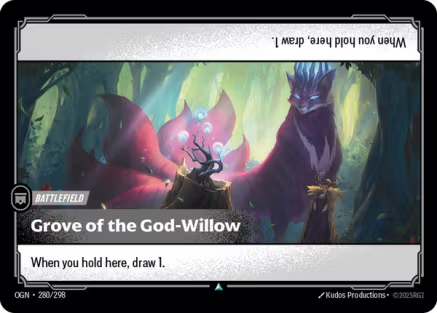
Riftbound is a competitive trading card game built around territory control. You win not by destroying your opponent, but by capturing and holding strategic locations on the board called battlefields.
The Win Condition
Points to win
Earn points by conquering and holding battlefields.
Every battlefield you take scores a point — every turn you keep it scores another. Riftbound rewards both the aggressor and the defender. First to 8 points wins.
What You Bring
Every player comes to the table with three things:
| Component | Size | Purpose |
|---|---|---|
| Main Deck | 40 cards | Units, spells, and gear |
| Rune Deck | 12 cards | Your resource supply |
| Legend | 1 card | Your identity and core ability |
Your Legend defines how your whole deck is built and played. Two players can run similar cards and feel completely different based on their Legend.
Card Types
Hover or tap a zone to explore

Legend
Your identity card. Defines your deck's color identity, playstyle.
You may only include cards that match your Legend's color in your deck.
Hover or tap a zone to explore.
Click a card to learn more about each type.
The Resource System
Riftbound uses a separate 12-card Rune Deck. At the start of every turn you automatically gain 2 runes — no bad draws, no flood, no screw. The player going second gains 3 runes on their first turn only, compensating for the tempo disadvantage of acting second.
Cards cost runes in two ways:
click the rune to pay energy

Energy Cost
Runes are exhausted — temporarily tapped and unavailable until your next turn. Think of it like using a battery. You drain this turn, but it recharges and you can use it again next turn.
click the rune to pay power

Power Cost
Runes are recycled — returned to your rune deck and removed from your available supply. Paying Power is a long-term investment; use it to make big plays that set your rune pool back.
Typically you want to exhaust the rune for energy before recycling for power - sometimes unavoidable! This is where a neat trick called Floating comes into play. We will explain that later in the guide.
A Turn at a Glance
Every turn follows an ABCD sequence before the open Action Phase begins.
Awaken
Beginning
Channel
Draw
Action Phase
Pass
Scoring
Points flow in three ways:
- Conquer — move a unit to an uncontrolled or enemy battlefield and win combat there.
- Hold — at the start of your beginning phase, score 1 point for each battlefield you already control.
- Card effects — certain cards and gear grant points through unique abilities.
It's possible your opponent can conquer a battlefield on your turn! Cards like Ride the Wind can let your opponent steal control when you least expect it!
Strategic Choices
Every turn in Riftbound revolves around three recurring tensions. Your Legends's ability will often tip each one in a particular direction — which is why building around your Legend is the foundation of good deckbuilding.
Contesting both battlefields pressures your opponent everywhere but thins your forces. Committing to fewer locations guarantees holds but cedes ground.
Deploying resources now builds board presence. Holding them lets you react during your opponent's attacks — often the stronger position.
Pushing for new captures accelerates your score. Reinforcing what you hold protects your existing income. Both matter every single turn.
If you remember nothing else:
ABCD → play units → send them to battlefields → hold battlefields → reach 8 points.
Everything else builds on that loop.