Understanding the Chain
How responses and priority/focus work when both players can act.
The Chain is Riftbound's system for handling responses. Whenever a player plays a spell or activates an ability, a Chain is created — and both players can keep responding until no one wants to add anything more. Effects resolve in reverse order: last added, first resolved.
The Two States
At any moment the game is in one of two states: Open or Closed. All timing decisions flow from knowing which one you're in.
No Chain exists
The player with Priority can act freely
- Play a spell — this starts a Chain
- Activate an ability — this starts a Chain
- Move units, pass, or wait
Chain is active
Players alternate adding effects to the stack
- Only Reactions can be added
- Each response is placed on top of the stack
- Chain items resolve when both players pass
Returning to Open state doesn't happen all at once. After each effect resolves, priority returns and players get another window to respond. The game opens up one step at a time as the Chain empties.
How a Chain Builds
Open — someone acts
Closed — responses stack up
Both players pass
Top resolves — then repeat
The Stack
The Chain is a last-in, first-out (LIFO) stack. Here's a simple showdown chain exchange:
When both players pass, the top resolves first: your En Gaurd lands before the opponent's Gust — meaning your unit is gains benefits before the opponent's debuffs. This ordering is where the game's skill expression lives.
Acting last in the Chain gives you the most information and the most control. Pass last, spend last — let your opponent commit their resources first whenever possible.
Resolution, Step by Step
Top item resolves
Priority returns
Both pass — next item resolves
Repeat until the Chain is empty
Once both players pass and the Chain empties, that window is gone. You cannot re-enter a resolved Chain. If you miss your moment to respond, that moment has passed.
Chain in Showdowns
Combat introduces Focus — a layer on top of Priority that controls who can start a Chain. Once a Chain is active, it works exactly the same as outside combat.
Focus vs Priority
| Focus | Priority | |
|---|---|---|
| What it controls | Who can start a new Chain | Who can respond within an active Chain |
| Open state | Only the Focus holder can act | — |
| Closed state | — | Both players alternate adding Reactions |
| Who has it | Passes after each fully resolved Chain | Alternates between players |
Showdown Flow
Showdown begins — attacker gets Focus
Focus player initiates
Players respond
Chain resolves — Focus passes
Combat damage
Full Example
Scenario: You attack into a Combat Showdown. You have Focus. You play Ride The Wind, an action that moves and readies your unit. A Chain starts. After passing, your opponet plays Smoke Screen, a Reaction that gived your unit's might -4, The opponent passes. On top of Smoke Screen you play Defy, another reaction and pass. Both players will pass and let the chain resolve.
Both players pass. Resolution:
Defy resolves
Smoke Screen resolves
Ride The Wind resolves
Focus passes to opponent
Key Rules
| Rule | What it means |
|---|---|
| Actions only in Open state | You cannot play an action while a Chain is active |
| Reactions whenever with priority | Reactions can be added to an existing Chain |
| LIFO resolution | Last added always resolves first — no exceptions |
| One Chain at a time | All effects go onto the same Chain, not separate ones |
| Step-by-step resolution | Each item resolves individually — priority returns between each one |
| No re-entry | Once the Chain empties and both players pass, that window is closed |
The mental model: The Chain is a pause where both players take turns responding. When no one has anything left to say, it resolves — backwards. Mastering when to respond and when to hold back is where the game's deepest decisions live.
Chain Demos
Step through a live Chain exchange to see how effects stack and resolve. Click an example to expand it and step through it at your own pace.
Chain Demos
The game is in Open state and you have Focus. No Chain exists yet — you're free to play an Action. This demo will use Reactions
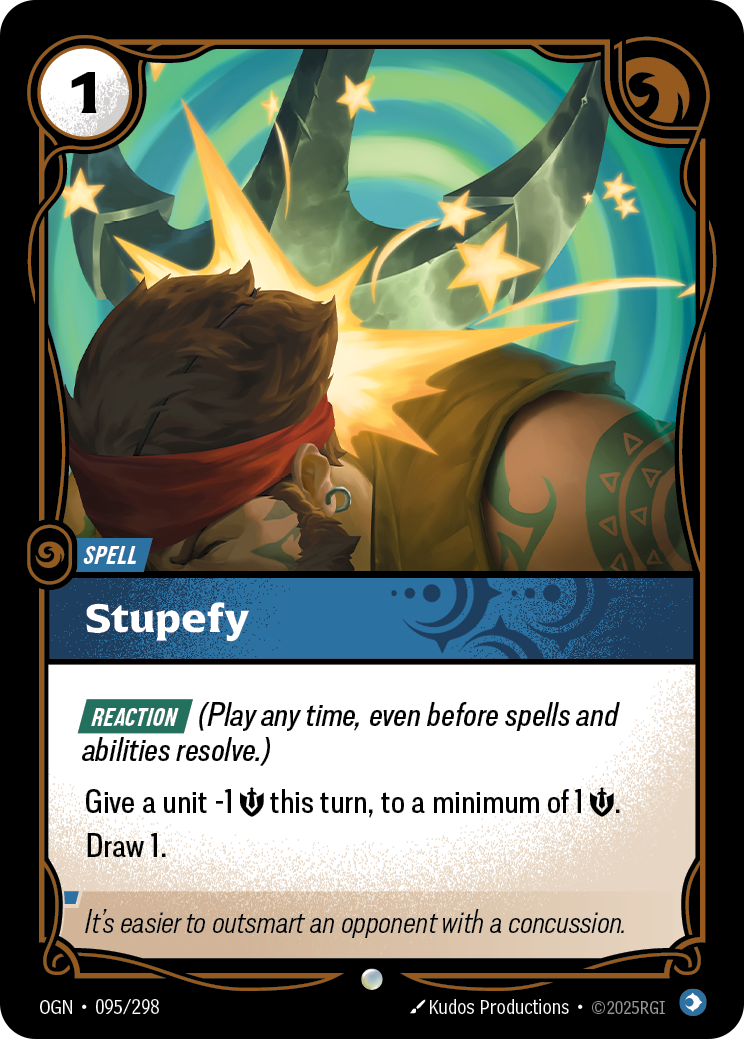
Stupefy
Open state. You have Focus. Actions can only be played in Open state — once a Chain exists, only Reactions can be added.
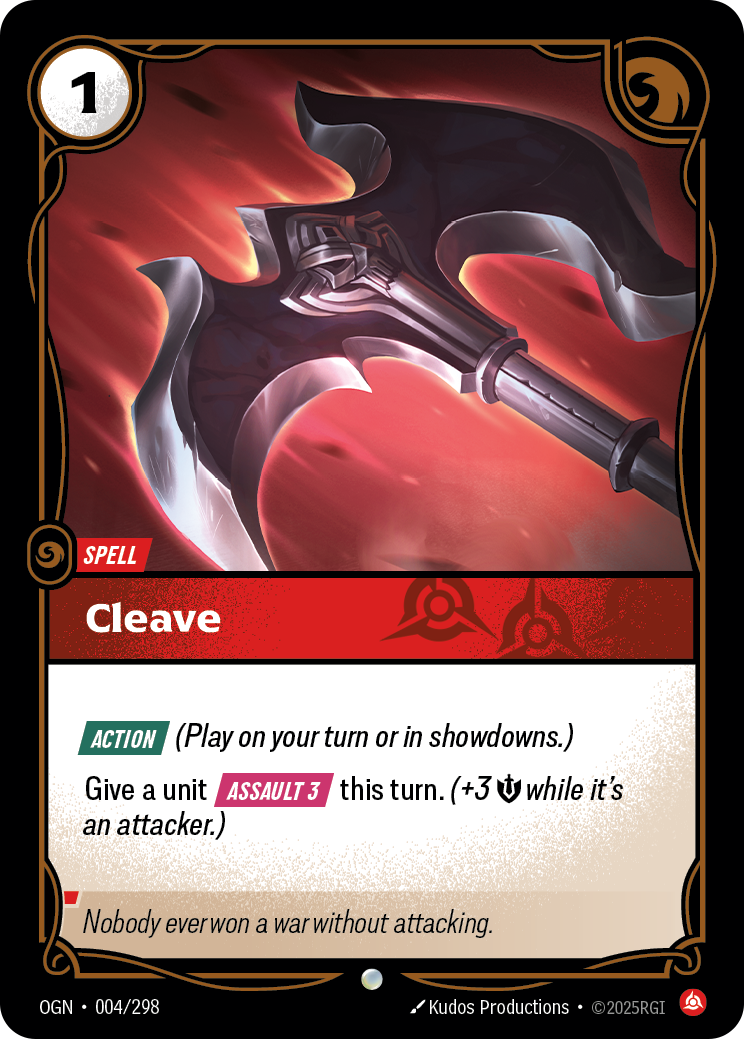
Cleave
Across both examples you saw the full Chain cycle in action. Here's how it all fits together.
Your Reaction
Reaction
Opp Reaction
Reaction
Your Action
Action
→ Reactions stack on top, one by one
Your Reaction resolves
Reaction
Opp Reaction resolves
Reaction
Your Action resolves
Action
→ Both players pass to begin resolving
Action speed
You can only play an Action when you have focus and when no Chain exists. It goes to the bottom and stays there.
Reaction speed
You can play reactions at any point in a chain. Every Reaction added goes above the previous entry — the Chain grows upward.
You play until you pass
You can play more than one spell before you pass, once you pass it's your opponents response.
Pass to resolve
When both players pass consecutively, no one is adding anything. Resolution begins.
Pass or Play
You can continue to play reactions as the chain is resolving. Play more or pass again to let the chain continue to resolve.
Last in, first out
The top of the Chain always resolves first. The Action you played first resolves last.